
Digitizing for Metallic Thread: Stop the Thread Breaks
Gold and silver threads are notorious for breaking. Here is the technical guide to running them smoothly.

Every embroiderer knows the sound. You load a beautiful cone of Gold Metallic thread, press start, and 10 seconds later0SNAP. You rethread the needle. 20 seconds later-SNAP. After ten minutes, you are ready to throw the machine out the window.
Metallic thread is the “Bad Boy” of the embroidery world. It looks incredible, adding a premium, high-value shine that customers love. But it is notoriously difficult to work with.
Here is the truth: It is not just your machine tension. It is your file.
If you try to run a file digitized for standard rayon thread using metallic thread, it will fail. Metallic thread requires a completely different set of digitizing rules. In this guide, we will break down the physics of why it breaks and the specific settings to fix it.
The Physics: Why Metallic Thread Breaks
To stop the breakage, you have to understand the structure of the thread. Standard embroidery thread (Rayon or Polyester) is spun smooth. It glides through the eye of the needle like water.
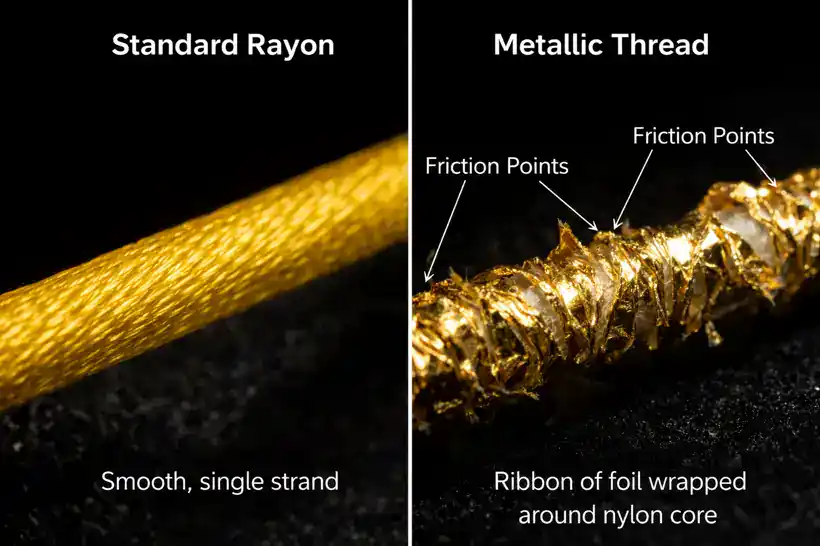 Left: Smooth Rayon. Right: Metallic (Foil wrapped around a core). Note the rough edges.
Metallic thread is different. It is actually a thin ribbon of metal foil wrapped around a nylon core. It has sharp edges. It is rough. It has “memory” (it wants to curl).
When this rough thread passes through the needle eye at 800 stitches per minute, it creates massive friction. If your digitizing creates tight knots or short stitches, that friction snaps the thread instantly.
Rule 1: Stitch Length (The 4mm Minimum)
The #1 cause of metallic thread breaks is short stitches. When the machine makes a tiny 1mm stitch, the thread has to bend sharply and reverse direction instantly. This kinks the foil.
 Standard stitch length (3mm) causes friction. Metallic optimization requires 4mm+ lengths.
When digitizing for metallic, you must increase your minimum stitch length.
- Standard Thread: Average satin stitch is 3.0mm.
- Metallic Thread: Aim for 4.0mm to 5.0mm.
Longer stitches allow the thread to “glide” onto the fabric rather than being punched into it. Avoid tiny detail work. If you have text smaller than 0.5 inches, do not use metallic thread.
Rule 2: Lower the Density
Because metallic thread is wire-wrapped, it is physically thicker than standard 40wt thread. If you use standard density (0.40mm), the threads will grind against each other as they lay down.
You must open up your density to 0.45mm or even 0.50mm. This gives the rough thread room to breathe. Paradoxically, because metallic thread sparkles, it reflects light and covers the fabric better than standard thread, so you don’t need as much density to get good coverage.
Rule 3: Pathing and Knots
In standard digitizing, we use “tie-ins” and “tie-offs” (tiny knots) to secure the thread. With metallic, these tiny knots are death. They create a cluster of needle penetrations in one spot, which shreds the foil.
The Solution: Use “Pixel Locking” or very gentle, long straight-stitch tie-ins. Avoid sharp 90-degree turns in your pathing. Think of metallic thread like driving a semi-truck-you need wide, gradual turns, not sharp corners. Learn more about pathing in our Sequencing Guide.
Rule 4: Hardware Adjustments (The Needle)
Digitizing is 80% of the battle, but hardware is the other 20%. You cannot use a standard 75/11 sharp needle.
You must use a Metallic Needle (Size 90/14). These needles have a specifically enlarged eye (a literal larger hole) that allows the rough thread to pass through without touching the sides. Combined with a slower machine speed (slow down to 600 SPM!), this will eliminate most breaks.
For more on hardware vs. software, read Why Digitizing Matters More Than Tension.
Want the ultimate luxury look? You CAN run metallic thread over 3D Puff, but you must be careful. The foam adds friction. Ensure your “cap” stitches on the ends of the letters are very loose. See our 3D Puff Guide for the basics.
Want Gold Embroidery That Actually Runs?
Stop fighting with thread breaks. We digitize files specifically optimized for metallic thread properties.
Get a Metallic Quote ($14.88 Flat)Turnaround in 4-6 hours.
Serving California’s Apparel Decorators
We provide specialized digitizing support for print shops in our key hubs:


