
Sneaker Embroidery Digitizing: Master Thick Leather.
Customizing footwear is highly profitable. However, it is also very risky. First, thick leather destroys needles instantly. Next, rigid canvas snaps threads easily. Therefore, you absolutely need specialized sneaker embroidery digitizing to protect your expensive inventory today.
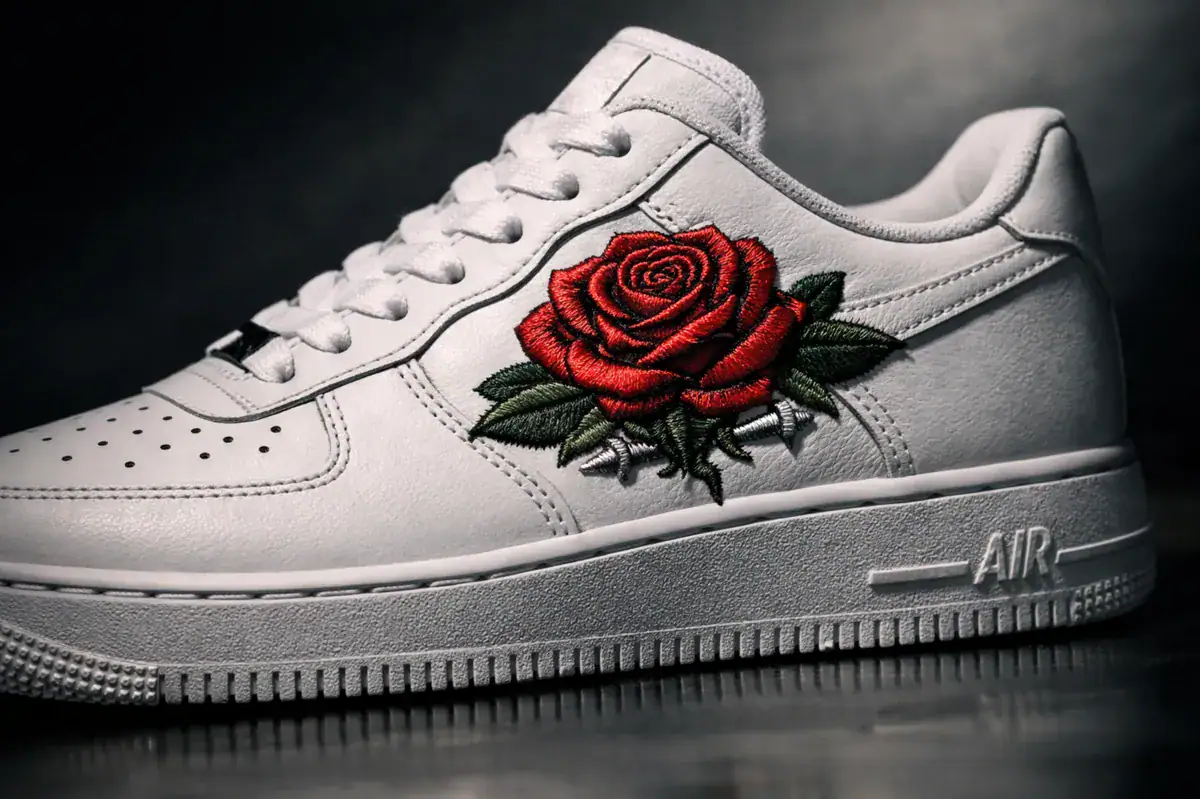
The Danger of Standard Files on Custom Sneakers
Many beginners do not truly understand what embroidery digitizing is when they start customizing. First, they buy an expensive pair of Nike Air Force 1s. Next, they purchase a cheap embroidery file online. Finally, they hit start. Consequently, the needle snaps violently, damaging the shoe permanently.
You simply cannot use a standard t-shirt file on a shoe. A cotton shirt is soft and forgiving. Conversely, leather is incredibly hard and rigid. Standard files have massive stitch density. Therefore, they create solid, bulletproof spots that destroy commercial machine heads rapidly.
- Needle Breaks: Heavy density snaps titanium needles instantly upon impact.
- Leather Perforation: Too many needle penetrations cut the leather entirely.
- Thread Fraying: Thick canvas shreds standard polyester threads rapidly.
The Structural Solution
Proper sneaker embroidery digitizing requires an entirely different digital approach. We drastically reduce the total stitch count. Furthermore, we increase the spacing between individual needle drops. As a result, the top thread lays flat on the surface without tearing the tough leather underneath.

How We Engineer Sneaker Files
Our manual digitizers understand footwear physics perfectly. We never use automatic tracing tools. Instead, we engineer your design stitch by stitch to ensure maximum rigidity.
Strategic Underlay Application
First, we build the foundation carefully. Choosing the correct Embroidery Underlay is vital. We use edge-walk underlay instead of heavy tatami grids. This secures the design outline firmly to the leather. Furthermore, it prevents the material from shrinking or warping under extreme thread tension.
Eliminating Micro-Penetrations
Second, we protect the material’s integrity. Every time the needle drops, it cuts a microscopic hole. If holes are too close together, the leather rips completely like a perforated postage stamp. Therefore, we use longer stitch lengths. We intentionally widen the density so your shoe remains structurally intact forever.
The Physics of Needle Deflection
Why do needles break so often on custom shoes? It is usually due to seam deflection. When a high-speed needle hits the thick junction where the tongue meets the side panel, it does not pierce straight through. Instead, it bends slightly.
This tiny deflection causes the needle tip to strike the metal rotary hook underneath. Many novices blame their machine tension when this happens. However, the real problem is the digital pathing. Our digitizers manually map these danger zones. We reroute stitching paths to avoid heavy seams entirely. Therefore, your production run is smooth and uninterrupted.
Push, Pull, and Curved Surfaces
Shoes are not flat. They are highly curved, three-dimensional objects. When thread pulls tight across a curved surface, it distorts the logo severely. We manually calculate the Pull Compensation to counteract this physics problem. We stretch the digital file so it sews out perfectly proportioned on the actual shoe.
Perfecting Complex Streetwear Details
Streetwear designs are often incredibly complex. For example, clients constantly want tiny text logos or detailed roses placed on the heel tab. However, small details often turn into messy, illegible blobs on tough canvas materials.
Navigating Tiny Elements
Digitizing Small Text on leather requires extreme precision. We solve this through manual pathing rules. First, we program the needle to start from the center. Next, we work outward toward the edges. This pushes the material evenly. Therefore, the logo never looks crooked or distorted on the curved surface.
The 3D Puff Trend
Many customizers want raised, 3D foam lettering on their sneaker tongues. Digitizing 3D Puff on footwear is incredibly difficult. We must cap the ends of the foam perfectly so the white foam does not poke through the colored thread. We specialize in capping these columns for flawless foam execution.

Footwear Specific Digitizing Rules
Different shoes require drastically different digital treatments. We adjust our software settings based on your exact footwear brand and material texture.
| Shoe Material | The Common Problem | Our Digital Solution |
|---|---|---|
| Smooth Leather (Nike AF1) | Needle cuts out the logo entirely like a cookie cutter. | Low Density Fills. We space stitches far apart to prevent perforation. |
| Heavy Canvas (Converse) | Rough texture shreds the top thread repeatedly. | Longer Stitch Length. We extend the thread paths to avoid high friction. |
| Suede / Nubuck | Stitches sink completely into the fuzzy texture and disappear. | Knockdown Base. We add a light structural grid underneath the main logo. |
| Nylon Tongues (Jordan) | Thin, slippery material puckers and wrinkles badly. | Double Zig-Zag Underlay. We stabilize the slippery fabric perfectly before filling. |
Sneaker Digitizing FAQ
Will this file work on any embroidery machine?
Our files are engineered flawlessly. However, embroidering shoes requires specialized physical equipment. For example, you absolutely need a heavy-duty commercial clamp frame to hold the shoe rigid. Furthermore, you must use specialized titanium-coated sharp needles. The file is perfect, but your hardware must match the extreme task.
Do I need to specify the shoe type?
Yes, absolutely. When you request your sneaker embroidery digitizing quote, you must tell us the exact material. A file built for canvas will not sew correctly on heavy leather. We optimize the density and underlay settings based specifically on your project notes.
Can you digitize over the shoe’s toe box?
Yes, we can. The toe box area is extremely stiff. Therefore, we use a highly specific, low-density “open fill” technique. This prevents your commercial needle from snapping upon impact with the reinforced toe cap material.
What if the design is too detailed for a shoe?
Footwear limits logo size greatly due to the curved embroidery area. If your design has tiny text under 4mm, it will likely fail on thick leather. Therefore, our experts will simplify the artwork gracefully. We ensure the final product looks incredible without destroying the material.
What thread type should I use for sneakers?
We highly recommend using strong polyester thread for sneakers instead of rayon. Sneakers take a lot of physical abuse from walking and weather. Polyester is bleach-resistant and holds up much better against abrasion. Our files are mapped perfectly for 40-weight polyester thread.
Looking for more high-ticket niche services?
In addition to custom footwear, our agency partners frequently rely on us for thick, difficult fabrics. Read our technical guide on horse blanket digitizing to learn how we master heavy wool and canvas equestrian gear.
Don’t Ruin Expensive Shoes.
Get a production-ready DST file engineered specifically for thick leather and heavy canvas today.