
The Safety Protocol: Digitizing for FR (Fire Retardant) Clothing
In the Oil & Gas industry, a bad stitch isn’t just ugly-it’s a liability. Here is the engineering guide to digitizing for NFPA 2112 compliance using Nomex and Aramid threads.

Standard polyester embroidery thread melts at roughly 480°F. In an Arc Flash or Flash Fire event, polyester thread will melt into the wearer’s skin. You MUST use Fire Retardant (FR) thread (typically Nomex® or Aramid) for any garment rated for NFPA 2112 or NFPA 70E compliance.
But here is the problem: FR Thread does not behave like Polyester. It is thicker, wiry, and breaks easily if digitized incorrectly.
The “Wire” Problem: Why FR Thread Breaks
Digitizing for FR gear is like stitching with copper wire. The thread has almost zero stretch and high friction. If you use standard “shirt settings,” the thread will snap every few hundred stitches.
Additionally, the fabrics (like heavy FR Canvas or Modacrylic blends) are dense. To prevent thread breaks, we must alter the physics of the design.
The Bobbin Trap
Pro Tip: It doesn’t matter if your top thread is Nomex if your bobbin thread is polyester. You MUST use 100% Spun Aramid (FR) Bobbin Thread. If you don’t, the back of the embroidery becomes a melting hazard.

The 3 Rules of FR Digitizing
We treat FR garments with the same care as “Hard Goods.” We focus on reducing friction and heat buildup.
1. The 20% Density Drop
FR Thread is roughly 30-40 wt (thicker than standard 40 wt poly). If you use standard density, the design becomes “bulletproof” and stiff. We reduce density by 20% to allow the fabric to breathe and maintain its safety rating.
2. Edge Walk Anchors
Because the thread is “wiry,” it doesn’t lay flat easily. We use a double Edge Walk Underlay to pin the edges down before filling. This prevents the “sawtooth” effect on the edges of letters.
3. Speed Limit: 600 SPM
Friction creates heat. Heat weakens Aramid fibers. We recommend slowing your machine down to 600-650 SPM. It takes longer, but you save time by not re-threading the needle every 2 minutes.
Pass vs. Fail: The Difference
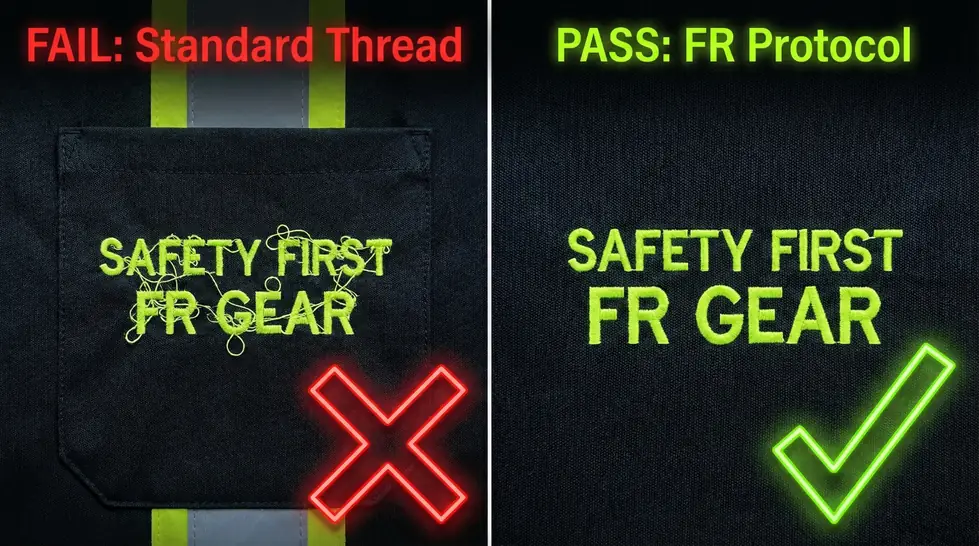
Left: Standard density causing thread shredding. Right: “FR Protocol” with open spacing.
FR Settings Cheat Sheet (Nomex/Aramid)
Use these settings to ensure your machine runs smoothly on Bulwark, Carhartt FR, and Tyndale gear.
| Setting | Standard Polyester | FR / Nomex Thread |
|---|---|---|
| Needle Size | 75/11 Ballpoint | 90/14 Titanium Sharp (Must be larger!) |
| Minimum Text Height | 0.20 inches (5mm) | 0.30 inches (8mm) (Cannot go smaller) |
| Density (Spacing) | 0.40mm | 0.45mm – 0.50mm (Open it up) |
| Underlay | Tatami / Fill | Edge Walk + Center Run (Low Bulk) |
The “Name Tag” Nightmare
The most common request in the industrial sector is: “Put the employee name on the right chest.”
This is where most shops fail. Because FR thread is so thick, it cannot handle small, detailed serifs. If you try to sew a name at 0.25″, it will look like a blob of orange yarn.
The Fix:
- Minimum Height: Enforce a strict 0.30″ minimum for names.
- Font Choice: Use simple Block fonts (Arial, Block 2). Avoid script or serif fonts.
- Character Spacing: Increase kerning (spacing between letters) by 15% so the letters don’t touch.
See more in our Small Text Guide.
Liability & Certification
Disclaimer: While we provide digitizing files optimized for FR materials, the final safety certification of the modified garment lies with the embroiderer. Always ensure your backing, bobbin, and top thread match the garment’s safety rating (e.g., NFPA 2112, ASTM F1506).
Frequently Asked Questions about FR Embroidery
Does embroidery void the warranty on FR clothing?
It depends. Embroidery can compromise the fire rating if non-FR thread is used. However, if you use certified FR thread and backing, and keep the logo size reasonable, most manufacturers (like Bulwark) allow it. Always check the garment spec sheet.
Why is my FR thread shredding?
Two reasons: 1) Your needle is too small (use a #90/14), or 2) Your speed is too high (slow down to 600 SPM). The eye of a standard #75 needle is too narrow for thick Aramid fibers, acting like a cheese grater on the thread.
Can I use 3D Puff on FR Hats?
Technically yes, but it is very difficult. The foam used for 3D Puff is highly flammable. You must ensure the foam is completely encapsulated by FR thread, or use a specific fire-retardant foam (which is hard to find).
Safety is Not Optional.
Don’t risk a lawsuit or a failed inspection. Get files engineered specifically for NFPA 2112 compliance and FR materials.
